Before the Birthday Card: How Written Greetings Travelled
Before the birthday card, written greetings travelled as letters, printed verses and messages carried by hand. Learn what each form suited and choose yours.
The common mistake in tracing written greetings before the birthday card is to treat every earlier message as a card in waiting. That misses the point: a letter, a printed verse and a message carried by hand each travelled differently, and each reached a different audience. If you are choosing how to send a greeting now, those distinctions still help.
There is no single route from an old spoken wish to the familiar shop-bought card. People could write privately, ask someone to deliver a note, or use printed words that circulated beyond one household. Rather than claim one form replaced another everywhere, it is more useful to ask what each route allowed a sender to do.
Greetings by hand
A spoken wish reached people gathered in the same place. It could be tailored in the moment, with a name, a joke or a few words of affection, but it depended on presence. If someone could not attend, another person might carry the message on. That relay made the wish possible, though the messenger might remember only its gist rather than the exact wording.
A written note carried by hand offered a different kind of control. The sender could choose the words, and the recipient could read them when there was a quiet moment. A household member, friend or traveller might pass the note along; the message’s privacy depended on the carrier and the circumstances, not just the paper.
Imagine a relative unable to join a family meal who writes a brief birthday wish and asks a visiting aunt to deliver it. The aunt hands over the folded note, and the recipient can read the sender’s exact words later. The trade-off is clear: the note preserves wording, while its arrival still depends on another person’s journey.
Letters across distance
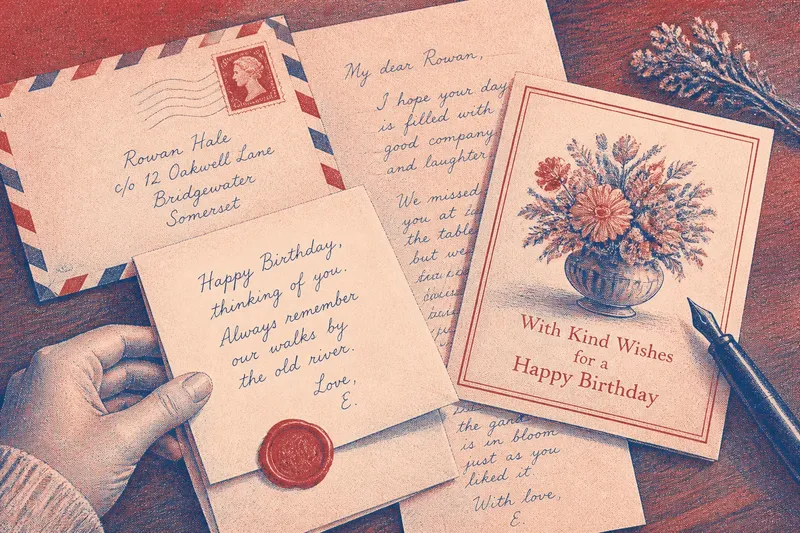
A letter used postal or other available delivery routes to reach someone who was not nearby. Its space suited news, memories and greetings that needed more than a line. Handwriting could make the sender recognisable, while the envelope directed the message to a particular person rather than to a public audience.
That privacy was never absolute: someone else might handle or open the letter, and delivery depended on the route available to the sender. A letter could also arrive after the occasion. Its strengths were room and a personal voice, not speed or certainty of timing.
For a greeting that includes family news or an explanation, a letter gives the writer more room than a small card. For a brief wish, that extra space may be unnecessary.
Printed greeting routes
Printed greetings offered words prepared for more than one recipient. A sender could select a suitable verse or message, then pass it on, send it or add a personal line. Unlike a private letter, a printed text did not have to be composed from scratch for each person; unlike a spoken wish, it could be read again.
Printed words could circulate through different channels, including personal exchange and public sale, but the route depended on the place and period. Without a specific dated example, it would be misleading to present a single sequence of printed forms as the universal path to the birthday card. The useful distinction is between a message made for one reader and language prepared to be reused.
A ready-made verse could help someone who found writing difficult or wanted a formal tone. The sender’s choice and any added note then supplied the personal element. If the wording felt too general, a few specific words could make the greeting sound directed rather than merely selected.
Cards and postal routes
A card combined an image, printed words and space for a short personal message in one object. Its design communicated a mood before the recipient read the note. A sender could post it or hand it over, depending on the occasion and available route.
Compared with a letter, a card generally left less room for a long account, but its surface could be kept or displayed. That made it both a message and an object. A bold joke, solemn image or affectionate illustration might suit one recipient and feel wrong to another, so the design needed to fit the relationship as well as the event.
Postal delivery gave cards a way to travel beyond the room where they were written, while hand delivery kept them close to the gathering. Neither method made the greeting inherently more sincere; each shaped when and how it was received.
Which route suits your greeting?
When is a spoken wish enough?
Use speech when you will see the recipient and a brief, personal message is enough. If the person is absent or may want to reread your words, write the greeting instead.
Should I send a letter or a card?
Choose a letter for news, explanation or a memory that needs room. Choose a card when its image suits the occasion and a short note will say what you mean.
What does a printed greeting add?
It provides a ready-made phrase or formal tone that can be reused. If it sounds impersonal, add a detail that belongs to your relationship with the recipient.
Match route to purpose
Say you need to greet an invented recipient, a friend called Rowan, who is away from a family birthday meal. Your starting point is a brief wish plus a personal memory, and you have no need to explain a complicated situation. First, consider asking a relative at the meal to pass on the words: that is direct, but Rowan would receive them second-hand. Next, consider a letter: it preserves your phrasing and gives room for the memory, but may arrive after the meal. Finally, consider a card with a short handwritten note and send it by post if timely arrival is not essential, or hand it over through the visiting relative if it is. The decision follows the purpose: use the card for a compact keepsake, the letter if the memory needs more space, or the spoken relay if prompt contact matters more than exact wording.
For a modern greeting, the old routes offer a simple way to choose. Ask whether the recipient needs your exact words, a longer account, a visual sign of the occasion or a message delivered in person. Before selecting a birthday card, decide what it needs to carry; that answer will tell you whether a card, letter, printed greeting or spoken wish is the better fit.