Keepsake Box or Open Shelf? Two Ways to Keep a Memento
Choose a keepsake box or open shelf by weighing access, visibility and available space, so a meaningful object stays easy to revisit without crowding your home.
The common mistake with a keepsake box or open shelf is choosing its home before deciding how you want to remember it. A box can make a memento hard to revisit; an open shelf can turn a private object into something you feel obliged to explain. The right choice depends on your habits, the object and the space you can spare.
Choosing between a keepsake box and an open shelf is less about finding the “best” storage method than matching a memento to everyday life. Consider how you use the memory, check what the object needs, then choose a place you can maintain.
Start with the memory
Begin with the object’s meaning, not its size or appearance. A ticket stub might bring back the sound of a family outing; a smooth stone might recall a quiet walk. Ask yourself what you value about keeping it. Is it something you like to see often, or something you prefer to take out on particular occasions?
Think about how remembrance already fits into your day. Perhaps you glance at a photograph while making tea. Maybe you open a drawer when you are sorting letters, or take out a small collection when relatives visit. These ordinary habits are useful clues: choose a home that supports the way you naturally return to the memory.
It can help to say the answer plainly: “I want to see this as I pass,” or “I want to keep this safe and look at it when I choose.” You do not need to make the object earn its place by being displayed.
Check the object
Before choosing a box or shelf, look closely at what you are keeping. Paper, fabric, photographs, shells, badges and small ceramics have different practical needs. A loose button or folded note is easy to contain; a wide postcard or fragile ornament may need a flatter, steadier place.
Notice whether the item is easily bent, faded, dusty or knocked over. Ask whether it has loose parts, a sharp edge or a surface that might mark another object. If it came with care instructions, or its material raises a preservation concern, follow the maker’s guidance or ask an appropriate conservator. For an everyday keepsake, the simple aim is to avoid obvious pressure, spills and rough handling.
Also consider whether the memento has other pieces that belong with it. A programme and ticket from the same event may make more sense together than separated across the room. Keep related items together only if doing so makes them easier to find and does not crowd or damage them.
Picture the everyday
An open shelf makes a memento visible without asking you to remember where you put it. That can suit a sturdy object you enjoy seeing in passing: a small ceramic dish, a framed note or a souvenir from a place you still talk about. It also gives visitors a chance to notice the object, which may invite a story.
Visibility has a trade-off. Objects on open display gather dust and can be bumped during cleaning or ordinary household activity. A shelf may also make a personal keepsake part of the room’s public appearance. If that feels uncomfortable, display does not have to mean putting it in the most prominent spot; a quieter ledge or a small cabinet with a door may offer a middle ground.
A box keeps an object out of view and can gather related mementos in one place. It suits items you revisit in a deliberate moment, or those you would rather not have on show. The exchange is that you must remember the box’s location and make time to open it. A box that is difficult to reach can become a place where memories disappear from daily life.
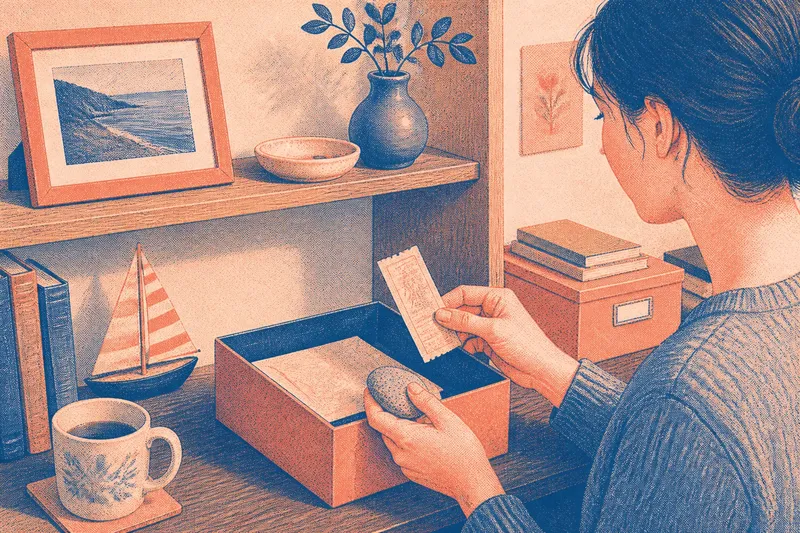
Say you have a paper admission ticket from an afternoon with a friend and a little stone from the same walk. Imagine you like telling the story when that friend visits, but do not want either item on display every day. You could keep the ticket flat in a labelled envelope inside a small box and place the stone beside it; the expected result is that both are easy to find together when you choose to revisit them, without taking up a visible surface.
Measure the available space
Look at the actual place the memento might live. For a shelf, check whether the object can sit securely without leaning against books or hovering near an edge. Leave enough room to dust around it and to remove it without shifting a row of belongings. A shelf can feel crowded even when every object technically fits.
For a box, decide where it will sit and whether you can reach it comfortably. A box on a high cupboard may be out of sight but also out of mind. A small container in a drawer may be easier to revisit, provided it is not buried beneath items you move constantly. If the keepsake is delicate, avoid placing heavy things on top.
Let the home shape the choice rather than trying to create a display that does not suit the room. A narrow hallway shelf may work for one compact object, while a shared sitting room could call for a less conspicuous box. If the space is already busy, the memento’s value does not depend on giving it a prominent place.
Which home suits you?
Which keepsakes suit a box?
A box often suits small, portable items you want to keep together or revisit privately, such as cards, letters and paper souvenirs. Use an interior that does not press on the object, and keep related pieces in a simple envelope or folder when that helps you find them.
Which objects work on a shelf?
Choose a shelf for an object that is stable, comfortable to see often and easy to dust around. A framed photograph or robust ornament may suit display better than a fragile paper keepsake that can curl, fade or be knocked aside.
Can I use both methods?
Yes: display one representative object and store the related pieces together. For instance, a small souvenir can sit on a shelf while its note or ticket stays in a box nearby, giving you a visible reminder without spreading the whole collection around the room.
What if I keep forgetting the box?
Move it to a place you naturally visit, such as a desk drawer or a shelf near family photographs. You could also add a plain label that names the contents, so finding the memory does not depend on recalling exactly what went inside.
Make the choice easy
Use these checks before settling on a home:
- Access: Check whether you naturally pass the shelf or open the box. If you can reach it without moving other belongings, choose that spot; otherwise, move the box or object to an easier place.
- Visibility: Check whether you want to see the object often or keep it private. If seeing it feels welcome, choose a shelf; otherwise, use a box or a less prominent spot.
- Condition: Check for concerns about dust, sunlight, pressure or handling. If the item seems vulnerable, choose a sheltered place and follow applicable care guidance; otherwise, use the display or storage option that fits your habits.
- Company: Check whether the object belongs with a letter, photograph or another small item. If keeping them together makes the memory easier to revisit without crowding or damage, group them in a box; otherwise, place each where it is easiest to care for.
- Room: Check whether the object fits without crowding a shelf or making a box awkward to store. If ordinary cleaning and access remain straightforward, use that spot; otherwise, choose a quieter shelf or a more accessible container.
- Privacy: Check whether you would welcome questions from someone who sees the object. If you would, display it; if not, choose a closed or less prominent place.
If both options seem right, try the less demanding one first. Place the object in a box you can reach, or set it on a quiet shelf where it will not be disturbed. Notice whether you naturally look for it, enjoy seeing it, or leave it untouched. That observation can guide a later change without turning the decision into a permanent rule.
Let habits decide
A keepsake box is not a failure to display a memory, and an open shelf does not make a memory more important. Each gives an object a different place in the rhythm of a home: one keeps it gathered for chosen moments; the other lets it meet your eye during ordinary ones.
Once you have chosen, make the location easy to remember. Keep the box with other meaningful papers, or give the shelf object enough space to remain visible and undisturbed. Reconsider the arrangement if your room or routines change; a keepsake box or open shelf is useful when it lets you return to the memento in the way that feels natural to you.