The Handmade Must Match Myth
The handmade must match myth can turn lively differences into defects. Use this week-long routine to decide which variations belong and which need attention.
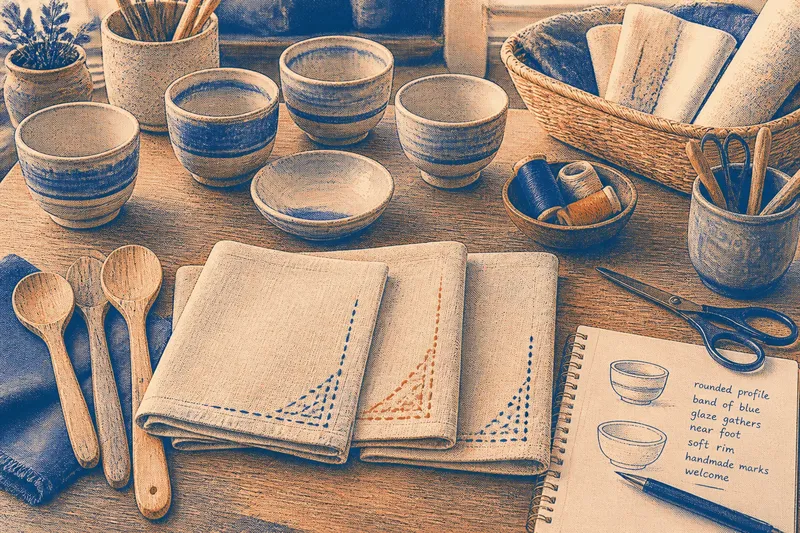
The most common mistake in handmade work is trying to make every finish match, then spending time sanding, repainting or remaking details that were never meant to be identical. The handmade must match myth can drain character from a set of bowls, stitched napkins or carved spoons before anyone has had a chance to use them.
A more useful aim is considered variation: differences that belong together because they share a material, purpose or visual rhythm. A week-long routine can help you decide what to keep, what to adjust and when to stop polishing a piece into sameness.
Choose a family resemblance
Before making a group of objects, name the features that should connect them. Keep this short and concrete. Perhaps your ceramic cups will share a rounded profile and a band of blue glaze, while their rims and brush marks may differ. A set of linen napkins might use the same cloth and hem, but each can carry a different hand-stitched corner.
This is not a demand for a perfect template. It is a boundary that makes variation legible. Without one, differences may feel accidental; with too many rules, every object becomes a copy.
- Check whether the objects share a material or colour; if they do, keep it as a visual link, and if they do not, choose a different shared feature.
- Check whether one feature repeats, such as a curved handle or visible seam; if it does, let other details vary, and if it does not, add a simple recurring feature.
- Check which details vary, such as glaze pooling, stitch spacing or wood grain; if the variation suits the material, leave it, and if it distracts from the group, adjust the next piece.
- Check whether each object works consistently, such as having a stable base or comfortable grip; if it does, leave the finish alone, and if it does not, repair the functional problem.
- Check whether the shared choices fit the objects’ intended use; if they do, write them on a scrap of paper, and if they do not, revise the choices before making more.
- Check whether your note is short enough to consult while working; if it is, leave it beside your tools, and if it is not, reduce it to a few concrete features.
Make a reference piece
Make one object to establish the family resemblance, not to serve as a flawless master. Put it where you can see it while working, and notice what makes it feel like yours: a slightly uneven rim, a broad wash of colour, a particular scale of stitch.
Keep a record with a quick sketch or a few words. “Blue gathers near the foot” is more useful than “make it beautiful”. Avoid treating every mark on the reference as a rule. Some will be choices; others may simply be what happened during that session.
Work in a small group
Make the next few pieces close enough together that you remember the decisions you made, but pause between them to look rather than rushing through a whole batch. For pottery, compare the shapes before firing and allow glaze to behave differently across the surface. For mending, use the same thread family while letting the darn follow the tear instead of forcing a square patch where it does not fit.
If a difference catches your eye, ask what kind it is. Does it help the object show its material and making, or does it interrupt the shared character you chose? A ridge in a hand-thrown bowl may be welcome; a sharp snag on a cloth edge may not be.
Inspect by use
Set the objects together in the place they are meant to live. A row of cups on a kitchen shelf tells you something a close inspection at the workbench cannot. So does a stack of napkins laid beside plates. Look at the group from ordinary viewing distance, then handle each item as its future owner might.
Check function separately from finish. A visual difference can be appealing while a wobbling base or loose join needs attention. Conversely, a harmless variation in colour or line does not become a defect simply because another piece looks different.
Ask: does each object belong to the group, and does each do its job?
Make one adjustment
Choose only changes that answer a clear concern. You might soften a rough edge, secure a loose thread or alter the next handle slightly because the earlier one feels awkward to hold. Do not repaint an entire set merely because one surface has a stronger mark than the others.
Say you are making a family of small clay dishes, and one has a darker patch where the glaze gathered. If the dishes share their shallow shape and pale blue colour, you might leave the patch and adjust only a sharp foot on another dish. The expected result is a set that reads as related while remaining visibly handmade, with the functional irritation removed.
Let differences speak
Arrange the finished work in more than one order. A sequence from light to dark can make colour changes feel deliberate; a loose mix can bring out contrasts in texture. For stitched items, alternate the corners with denser thread. For wooden pieces, turn the grain in different directions so the variation is easy to notice rather than mistaken for a mismatch.
This is presentation, not disguise. You need not hide the piece that looks unlike its neighbours. Instead, see whether placement gives its difference a context. If it still feels out of place, consider whether the shared features were too vague or whether this object belongs in another group.
Keep, repair, or regroup
On the last day, make an actual decision for each piece: keep it as it is, repair a functional or defining problem, or place it in a different group. Compare the objects together at ordinary viewing distance, then handle them as intended. Record the reason beside each decision, so the routine ends with a clear answer rather than an open question.
Imagine you have three linen napkins made from the same cloth, each with a hand-stitched corner. One corner has denser stitching, and another napkin has a loose thread. First, compare the napkins on the table: the shared cloth and hem make the denser corner feel related, so keep it. Next, handle the loose thread and check whether it catches; if it does, secure it, then check that it lies flat. The result is a set that keeps its visible variation while correcting a snag. If the loose thread does not catch and is simply a visible end, leave it rather than changing the whole set to match.
Questions about variation?
What variation looks intentional?
A repeated material, shape or colour can link objects while small shifts in line and surface show how each was made. Variation tends to feel intentional when it has a visible relationship to the group rather than appearing as an unrelated addition.
When should I remake a piece?
Remake or repair it when the difference affects safe, comfortable use or breaks a defining choice you meant to keep. If the concern is only that it does not match another object exactly, compare the pair at normal viewing distance before changing anything.
How do I make a handmade set feel cohesive?
Repeat a few recognisable features and let other details respond to the material. Cohesion comes from a family resemblance, not from making every surface, edge or stitch identical.
Should I explain the differences to someone receiving the work?
A brief note can help, especially if the variation is subtle or the objects are part of a set. Describe what connects them and what changes from piece to piece, without apologising for details you chose to keep.
Finish by noting which differences you welcomed and which ones you corrected, then keep the note with your tools or materials. The handmade must match myth is easier to resist when you know what your work is meant to share—and what you are happy to let differ.